Club statistician

Your modules, cell by cell. We proved it with a test, not a claim.

There is one big risk when changing tools: that the new program computes differently and nobody knows which number is true. That is why we started with agreement.

Sound familiar

  • You have tables refined over years and you do not intend to abandon them.
  • A new system usually means new results and a week of explaining where the difference came from.
  • Importing a sheet ends with “error in row 214” and nothing else.
  • Exports from an application never look like your file.
13
5×5 and 3×3 modules
610,045
action rows in the system
1:1
agreement with the sheet, guarded by tests

Thirteen modules carried over one to one

Nine 5×5 modules and four 3×3 ones — basic, time-based, row-based, zone-based, per player, restarts. The agreement is guarded by tests that compare the result cell by cell against printouts from the old program — quirks included, because agreement is agreement.

Sheet import with a validator that says what and where

You upload the file and get a list of problems with the row number, the rule name and a suggestion taken from the data — the nearest valid code, an adjacent time, the quarter of the neighbouring possessions. Nothing is applied on its own; you decide.

File check and comparison

Two sheets set side by side row by row, with agreement computed per column and a history of checks. This is a tool for settling arguments about numbers, not for hiding them.

An export that looks like your file

XLSX and CSV computed on the server, with the ordinal number and the formatting of the original. Column settings are remembered per user.

A rejected export stopped being a single sentence

When a game does not make it into the statistics, you get a list of problems with the rule, the field and the possession number, not an “import failed” message. The history of attempts is stored — including the ones that were stopped, because “what happened” is asked most often when something is missing.
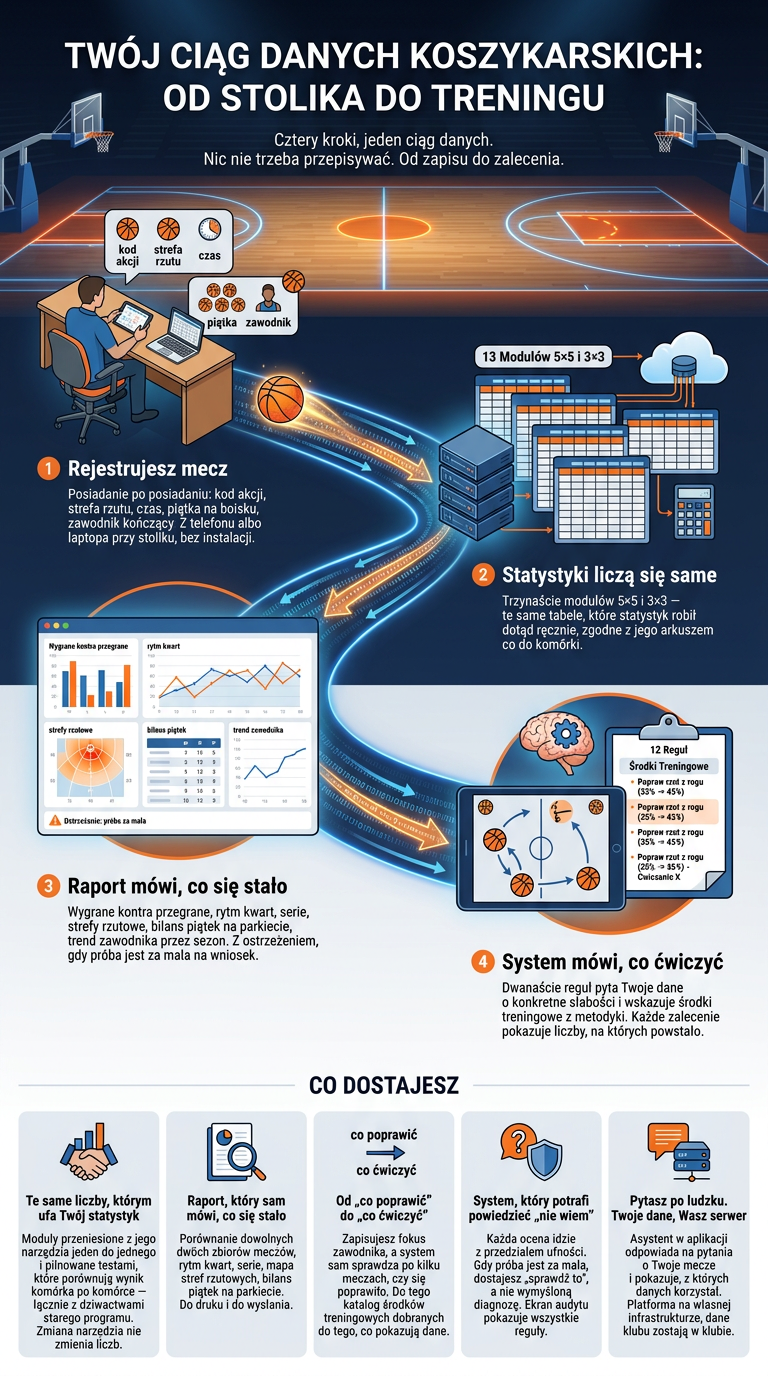
From the table to the training session — four steps, one chain of data

Nothing has to be retyped between tools. What you write down at the table travels all the way to the training recommendation.

Four steps: you record the game at the table, the stats compute themselves, the report says what happened, and the system points at what to practise.
  1. You record the gamePossession by possession: action code, shot zone, time, the five on court, the player finishing it — from a phone or a laptop at the table.
  2. The stats compute themselvesThirteen 5×5 and 3×3 modules — the same tables your statistician has been building by hand.
  3. The report says what happenedThe rhythm of the quarters, runs, shot zones, the balance of each five, a player's trend — with a warning when the sample is too small for a conclusion.
  4. The system says what to practiseTwelve rules ask your data about specific weaknesses and point at drills from the coaching literature.

If any cell computes differently after the migration, that is a bug to fix, not “a new methodology”. That is how we treat it.