Every section in one place
An organization has its own teams, players and games; one account can serve several organizations. There are three roles — owner, administrator, member — and they decide who can change things and who can only look.
Club board
A club usually keeps its statistics in three spreadsheets, its video somewhere else, and what it knows about the team in the head of a coach who may work elsewhere next year.
An organization has its own teams, players and games; one account can serve several organizations. There are three roles — owner, administrator, member — and they decide who can change things and who can only look.
Notes, tags, saved reports and player focuses belong to the organization, not to a person. So do conversations with the assistant — a new coach finds the full history, not an empty screen.
The platform is self-hosted: the database, the files and the backups sit on the server you point at. We do not sell access to your data and we do not mix it with anyone else's.
Adding a member, changing a role, deleting a game — everything leaves an entry in the event log. Deleting a game from the whole system is a separate, protected operation with a preview of what will disappear, before anything disappears.
The system holds over four thousand games from professional competitions, imported action by action. They serve as context — to compare your own numbers with the level of the league — and are clearly kept apart from the club's data.
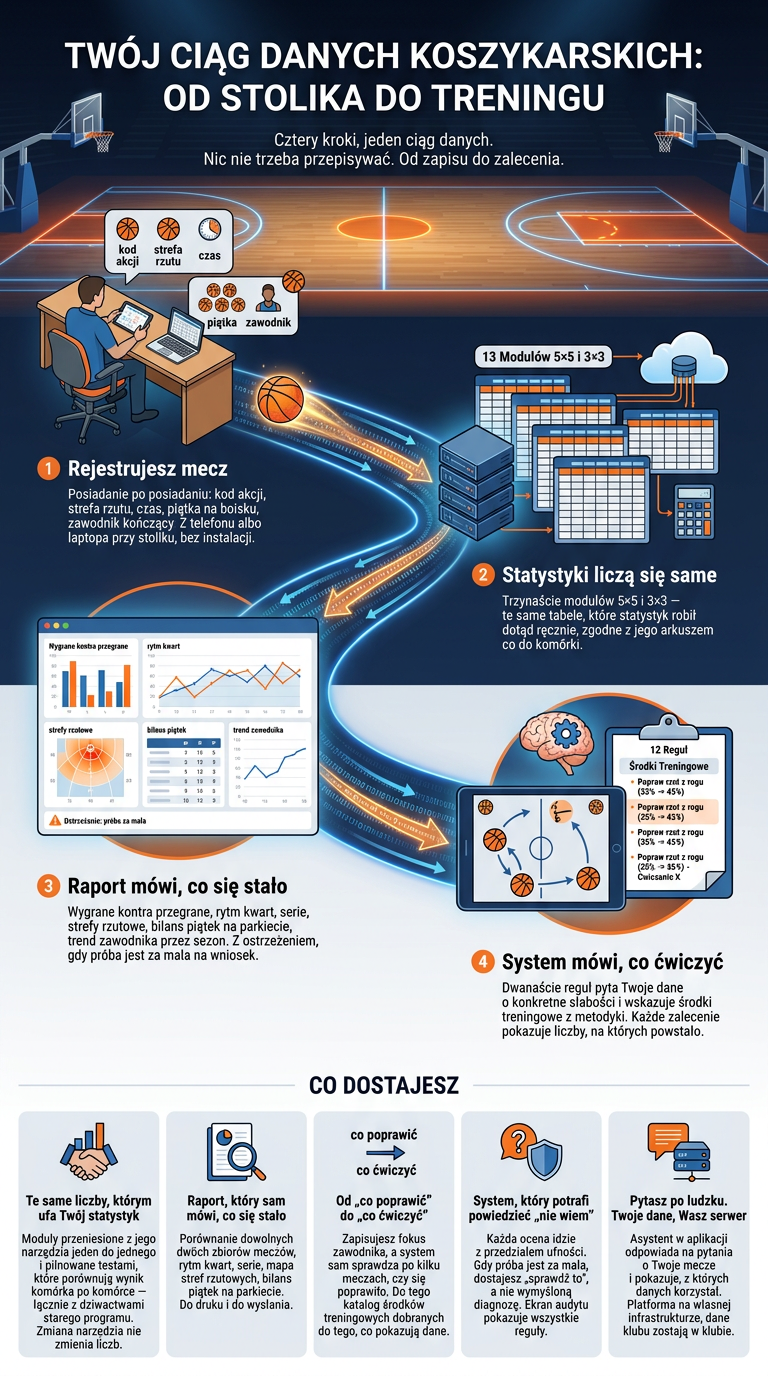
Nothing has to be retyped between tools. What you write down at the table travels all the way to the training recommendation.
You are buying a working tool for the staff and order in the club's data — not another subscription that leaves you wondering what is left when it expires.