Parent

How your child played — without knowing analytics.

A summary of the game written in plain language, and a way to ask about the details.

Sound familiar

  • You know the score, but not what actually happened.
  • A table of statistics is a set of abbreviations to you.
  • You do not want to bother the coach after every game.

A game card you can actually read

The rhythm of the game, where the points came from, runs, the shot map. Every section says what it shows, and when something was not recorded it says so plainly instead of showing zeros.

Ask in plain language

You can ask the assistant about a particular game or a particular player and get an answer based on the record of the game, with the numbers traced back to where they came from.

From the table to the training session — four steps, one chain of data

Nothing has to be retyped between tools. What you write down at the table travels all the way to the training recommendation.
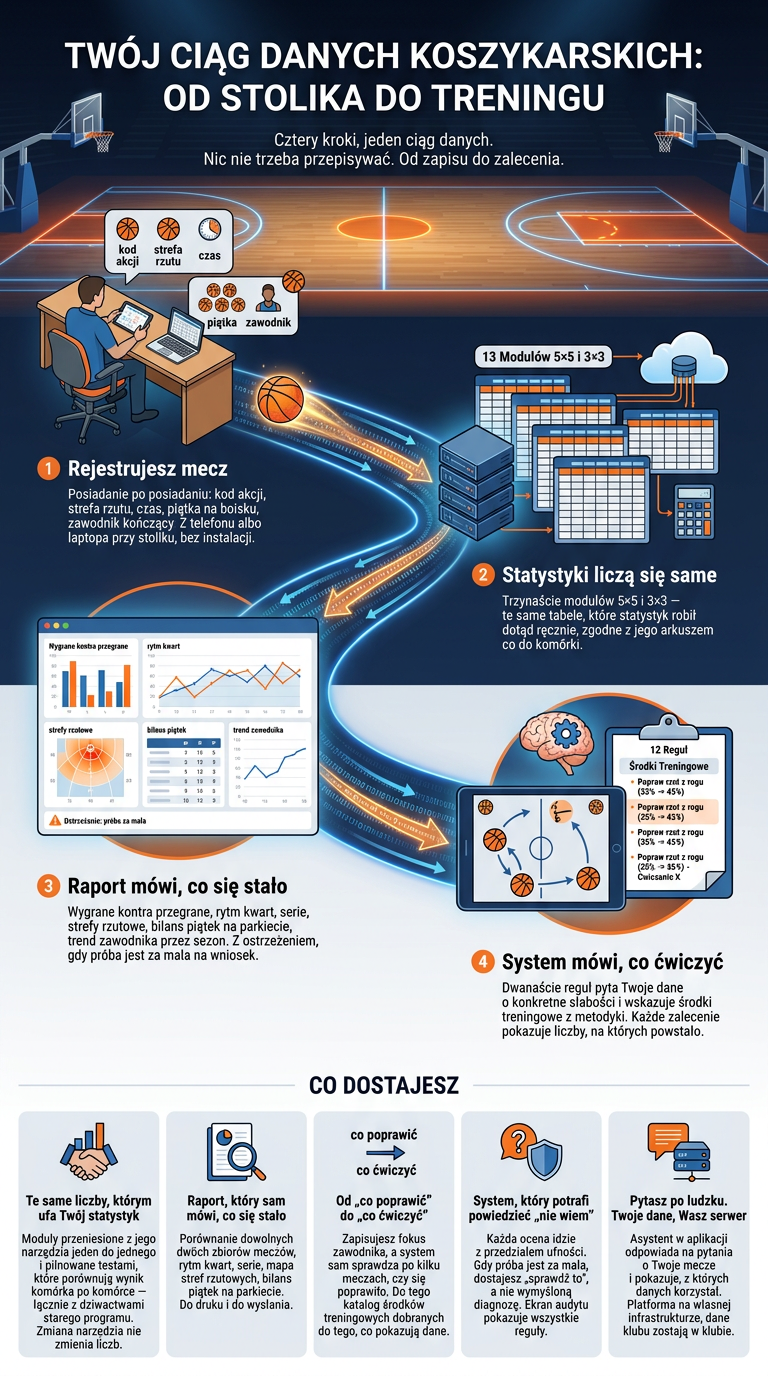
Four steps: you record the game at the table, the stats compute themselves, the report says what happened, and the system points at what to practise.
  1. You record the gamePossession by possession: action code, shot zone, time, the five on court, the player finishing it — from a phone or a laptop at the table.
  2. The stats compute themselvesThirteen 5×5 and 3×3 modules — the same tables your statistician has been building by hand.
  3. The report says what happenedThe rhythm of the quarters, runs, shot zones, the balance of each five, a player's trend — with a warning when the sample is too small for a conclusion.
  4. The system says what to practiseTwelve rules ask your data about specific weaknesses and point at drills from the coaching literature.

Access is granted by the club — the data belongs to them, not to us.